Posts Tagged ‘Hard drive trauma’

What to do if you dropped, kicked, tipped-over or subjected any hard drive with trauma #3?

Friday, October 14th, 2011

There is over 95% certainty that an operating drive that was dropped or kicked is seriously damaged, even if it keeps working after you pick it up.  Rarely does it continue to work after the trauma for more than a few hours, most of the time it may work for a couple of minutes with difficulty reading any files.  So if you keep using it you are taking a major gamble if you have valuable information on that drive.

Non-powered drives are much less likely to fail than powered ones.   But the problem is that the risk is still significant enough to be cautious.   The highest likelihood of damage to dropped non-powered drives, is for the READ-WRITE  heads to get deformed from the impact.  Powering a drive with such damage will most definitely cause severe platter media damage.   So what is the best action to take? “Let a qualified recovery lab check the sealed area of the drive”.  If they prove that there is no damage, go ahead and use it, but MAKE-A-BACKUP asap.   If there is damage, you have a choice to make.  The checkup should cost a minimal fee under $50, and some like Cherry Systems will do it for free.

What to do if you dropped, kicked, tipped-over or subjected any hard drive with trauma #2?

Friday, October 7th, 2011

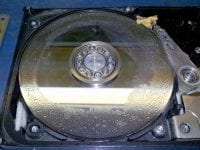
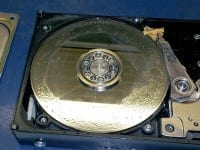
What happens to the media surfaces of a dropped drive?  If you are old enough to remember vinyl music records, you can visualize the needle being forcefully moved across the record surface and making a deep non-concentric groove, which often rendered that record unusable.  For the younger reader, think about a CD or DVD that made contact with a rough surface or is badly scratched and will not play anymore.  Similarly to the playback-head of a record player, the force of a dropped drive will cause the READ/WRITE heads to move across the platters and make several damaging contacts with the media surfaces.  The contact will typically dislodge a sizeable amount of the magnetic material, which will then be dragged along with the moving READ/WRITE heads, causing further damage.  You would be amazed how quickly the disk surfaces will deteriorate to a dusty-mess.  That is why we suggested in our first blog post on this subject to PULL-THE-PLUG!!

Because the damage is mostly to the media, there is absolutely nothing that a non-data-recovery-lab engineer can do.  An inexperienced attempt by anyone else, will only make things worse!

Next posting we will cover, what happens to a dropped drive which was not-powered at the time of the trauma.